
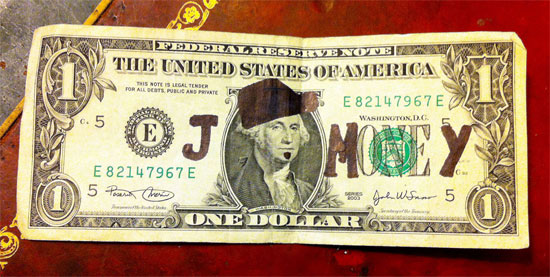
It’s actually true for everyone, but i couldn’t resist the catchy-ness ;) As I was heading off to bed last night, it occurred to me that i have yet to write a posting on budgets! I mean, who has a blog titled “Budgets are sexy” w/out talking about budgets? Jeesh, what a loon. So, without further adieu, this is why budgets are a man’s (and everyone else’s) best friend.
budg·et (n): A systematic plan for the expenditure of a usually fixed resource, such as money or time, during a given period. American Heritage Dictionary
The keyword here being “plan”. Without one, we’re just guessing that all is a-okay. 3 months ago i thought i was The Man w/ money! I had purchased a house, a newish car, paid all bills on time, invested, and still had $ for splurging. Unfortunately I was living in la la land. When i actually sat down and calculated exactly what came in and out, I was overspending at LEAST $400.00 each month! Can you believe those apples? ME, The Man, was actually losing money each month? I was a bit surprised my friends, a bit surprised.
After i wiped the tears away, i got my ish in order and promised to stick with it. I’ve been using a budget for a little over 3 months now, and i gotta say i am feeling pretty damn good about it! I have a plan, i’m feeling good, and i’m saving money.
The calculations don’t lie: Budgets = Confidence = Sexy.
The biggest hurdle on budgeting is actually GETTING STARTED. Once you do that, even if you don’t follow it 50% of the time, you’re a billion times better than you were before. I’m not gonna say it’s easy, but it’s definitely do-able. Here’s 4 simple ways to get started:
- KNOW where you’re money’s going: As G.I. Joe once said, “Knowing is half the battle!” Sometimes it’s scary to know exactly where it all goes, but unfortunately it’s the way of life. To do this, write down everything you spent money on during the previous entire month (ex. Jan 1-Jan31). Or better yet, copy and paste it all from your checking account statement into a blank Excel spreadsheet.
- Categorize them into 5 or so clumps for easy budgeting: The easiest way to budget is to see how much you’re spending in each category, compared to previous and future months. Clump them up into groups Like “Mortgage/Rent”, “Food”, “Utilities”, “Credit Cards”, and my favorite: “Random”.
- Create a “budget” around these categories: Now that you know how much you’re spending in each category, figure out if you’re happy with that amount. If not, set a goal to spend a little less the next month. I use a simple Excel spreadsheet (click here for the google doc) that compares both “budget” and “actual” amounts so I can track progress each month. Before this, I made “mental” budgets and I was astonished that i was shelling out $1100+ on my credit card each month! I had set a a budget in my head of $500 each month but it never got close. Once i realized how much i spent on it, and why, i came up w/ a personal budget of $800 for the “Credit Card” section.
- Reward yourself: With anything in life, we need some positive reinforcement sometimes to let us know we’re on the right track and to keep us going forward. Some people do this by going out to a nice dinner or picking up some new jeans, but either way it’s important to reward yourself for sticking to the budget (just don’t blow the money you just saved from your hard work!) Since I have gone UNDER my “Credit Card” category the past 2 months, I have taken the money and deposited it into my savings. It’s not your normal way to pay yourself on the back, but for ME it keeps me going :)
If you’ve read allll that and still don’t think it’s worth your time, try out one of the following free online budgeting sites. You’ll still have to spend a little bet setting up, but once you have it’s pretty much automated: Yodlee Money Center, PearBudget.com, and Mint.com.
Get blog posts automatically emailed to you!


After reading Budgets Are Sexy (and other PF blogs) off and on over the past year I realized I never did check out your beginnings. I plan to start my own blog of some sort so to keep motivated I’m taking a peek at the childhood of one of my most frequently visited blogs.
As this article says, I’m in need of a plan. Not just a plan for my finances, but for life in general. Keeping my thoughts bouncing around in my head leads nowhere. Time for me to open the word processor and mash away at the keyboard. I say, what better way to get on the path I want than putting up the truth from where I can’t hide?
Anyways, your style here is awesome. It definitely inspires me to put my self out there.
You know it! Go and start one up – at the very least you’ll start keeping yourself accountable and probably learn a $hit ton in the process :) I wrote this post over SIX YEARS ago and now I do it full-time for a living – so you never know what types of opportunities may come too!
Right now I see the value of any lessons learned and personal growth to be far more valuable than making a penny from the blog. If by chance it winds up generating any sort of revenue, well, that’s just delicious butter icing on the cake. ;)
I like the way you think. And eat :)