
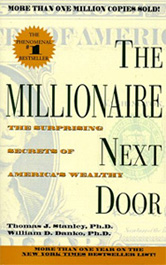
 BOOK: The Millionaire Next Door
AUTHOR: Thomas J. Stanley, William D. Danko
SEXINESS: 4 Thumbs ups! (toes count)
Tied for my all-time favorite financial book! Where as The Automatical Millionaire (the other favorite) shows you HOW to reach your goals, this book helps get your “financial mind” positioned right – and does so brilliantly!
There’s one defining concept portrayed throughout:
Always live below your means.
You do this, no matter your age, salary, etc, and your wealth will grow exponentially – and so will your peace of mind :) That’s not to say you can’t be a millionaire AND have fancy things, of course, but just that these guys choose not to.
Even if you DO earn a crazy high income, it doesn’t necessarily mean you’ll be rich (aka have a high net worth). The same holds true with the highly educated:
“How can well-educated, high-income people be so naive about money? Because being a well-educated, high-income earner does not automatically translate into financial independence. It takes planning and sacrificing”
Amen brother. If only they knew about our blogs! haha … So who are these Pimps?
According to Stanley & Danko, the average millionaire is:
- 57 years old, Male, and married with 3 children. 70% of them earn 80% or more of their household income.
- Self-employed (2/3rds of them). 1 in 5 are retired.
- A homeowner. 97% of them own homes, which are valued around $320,000.
- First-generation affluent (80%) – meaning they are self-made millionaires, not because they inherited all their money.
And, on average, they:
- Invest nearly 20% of their household realized income EACH YEAR.
- Have total annual realized (taxable) incomes of $131,000, with average incomes at $247,000.
- Live well below their means, wear inexpensive suits and drive American-made cars.
- Have wives who are planners and meticulous budgeters. (they know what’s up! Sexy all the way baby… i don’t care what others say).
- They have a “go-to-hell fund” – basically, enough to quit working for 10+ years if they really wanted.
- And, are mostly tightwads! haha… hence, one of the main reasons they agreed to complete a long questionnaire for a few crispy dollar bills.
This is all broken down throughout the chapters, so if you get bored with one pile of stats, you can easily move on to others. They also categorize high earners into what they call PAWS and UAWS, and then compare the differences between them. PAWS are “Prodigious accumulator of wealth”, and UAWS are “Under accumulator of wealth”. You want to be a PAW ;)
In all honesty, reading this book has become the financial ying to my yang. It goes right up there with the purchase of our house and living off a budget – I love it! You really do get to know their way of life, and it really sticks.
The ONLY thing i’d like to see is an updated version of this bad boy. While i’m sure this “way of life” hasn’t changed much over the years, i bet the stats sure have! A ton of stuff has happenend since this book published in 1996. (You hear that Stanley & Danko? If you do this for me, I promise you 1 (one) sale of this new book)
I totally recommend this book to anyone interested in furthering their financial education. A+ baby, all the way!
————
* You can buy the book here: The Millionaire Next Door
* And you can check out other book reviews here: Book Reviews
Get blog posts automatically emailed to you!



The book was pretty slim on practical advice. All it talks about is saving ad nauseum. Anybody can get rich by saving thousands of dollars for 50+ years. But what good is a million dollars going to do for a 70 year old person?
I say have fun and find smarter and faster ways to get rich.
I think the main part I got out of it was that your average millionaire doesn’t look how you’d normally think they do (no flashy cars, mansions, etc etc), that’s why I really liked it. That they’re incredible at saving even after hitting that threshold.
But yeah, it’s not for everyone :) It’s too bad all the comments got wiped out here during our WordPress conversion as we had some good discussion going…
The main idea I took from the book is that a million dollars is not a lot of money. I mean, the top 100 richest people in the world are billionaires. One billion = one million times one thousand. Does being a millionaire seem like a big deal when you aren’t even close to being recognized as rich?
A millionaire is just a person who will be envied by others but be taxed to death by the government. I definitely do not want to be a millionaire. It just does not make sense to work so long and hard for so little money.
Think BIGGER!
I have no problems at all becoming a millionaire. If you can save enough AND have fun/enjoy your life in the process, why not? And at the end of your good life you pass along your $ to your loved ones. I’m gonna keep striving for it – I don’t need/want a billion dollars, I’d go crazy.
^ Pass money down to loved ones? Not a chance.
I work for me and me first. I am not here to provide an easy life for others. I work to provide for my family and have fun here and now. I have enough insurance to take care of my funeral arrangements. Any debts or expenses that I have incurred die when I die. I came here with nothing and I plan on leaving with nothing except for pleasant memories and good times.
No one should ever expect their parents to leave them with money after they die. Passing down money is really for rich people. If you are working hard to leave an inheritance for others, you have failed. Anything that is left when I die will be a bonus.
Do your thing my friend – we’re all different ;)
I’m reading the book right now and loving it. I plan to take the million and use it to make exponentially more money.
Interestingly, the book says something about only 10% of millionaires receiving any inherited money, and they don’t plan to leave their money to thier loved ones. They expect their children learn the value of money and build their wealth their damn selves. Sounds like a good idea to me!
Yeah, right? Really really good book…. And one of the authors (Thomas J. Stanley) is on Twitter and really good at responding too! So you should totally hit him up when you’re done and let him know what you think ;)
http://twitter.com/thomasjstanley
Yadgyu’s comments are pretty dumb. Exactly the kind of person who would be an UAW in the book being reviewed. Granted, a million dollars isn’t all that much, but it is still infinitely better than being in debt or having no money.
Hell yeah – I’d take a million dollars any day! You could live off that for a while if you managed it well. And if you *worked for it* you’d have a much better appreciation too over winning it, say, in the lottery.
keep working hard for that 1 million dollars. That is baby money these days. You should feel ashameed if you don’t have 1 million dollars by the time you are 50. By the time you are 65, you should have at least 2 million dollars. Stop living below your means.
How are you planning on getting there? Or did you already make it?
This is kind of late to respond but I want to say something.
I just read the book this weekend and I loved it. I think a million dollars in assets is better than nothing even with inflation and all. From my perspective it didn’t seem to me like these millionaires were depriving themselves, although unfortunately that is what a lot of people seem to get from reading the book.
Although at first they did have to make sacrifices especially when starting out. It seems from every case that the authors talked to that the millionaires found a lifestyle they were comfortable with leading, while also making good money, saving and living below their means. I think why a lot of people don’t like this book is because companies are good at marketing products to us and having us part with our money and many of us end up broke.
So it seems like becoming the millionaire next door is overwhelming and impossible. For example, I’m in college, and the average college student doesn’t think there’s anything wrong with parting with $200-400 for a new smartphone. We just accept that’s “how it is” and it’s “normal for everyone to have a smartphone.”
So yes a million in the long run isn’t anywhere near a billion, but when you’re 65 would you rather be the person that has zero or the person with a million dollars in assets?
Preach on sister! Glad you got a lot out of it as I did back in the day :) I’m sure it’ll continue to inspire others for years and years to come too – it’s a classic.
This blog post made me go to amazon and buy the book. Thanks for making me spend money. :-P :-D
One of the few times spending money will actually get you to SAVE money! And hopefully millions of it ;)